The way we search for information online has undergone a fundamental change.
Instead of scrolling through lists of blue links, people are now getting direct, conversational answers powered by artificial intelligence.
This shift represents one of the most significant transformations in how we access knowledge since the early days of the internet.
What Are AI Search Engines?
AI search engines are advanced platforms that utilise artificial intelligence and large language models to understand your questions in context and provide direct, conversational answers, rather than just listing website links.
Unlike traditional search engines that rely primarily on keyword matching and page ranking algorithms, AI search engines interpret the intent behind your query, synthesize information from multiple sources, and present comprehensive answers in natural language.
These platforms combine several technologies, including natural language processing, machine learning, and real-time web access through a technique called Retrieval Augmented Generation (RAG).
This allows them to pull current information from across the web, understand context, and generate human-like responses while citing their sources.
Think of it this way: traditional search engines are like librarians who point you to shelves of books. AI search engines are like research assistants who read those books for you and deliver a summary with citations.
Why AI Search Engines Are Called Answer Engines
The term “answer engines” perfectly captures what sets these platforms apart. Traditional search engines deliver search results; AI-powered platforms deliver actual answers.
This distinction matters because user behavior has shifted dramatically. According to recent data, over 65% of searches now end without a single click to a website, a phenomenon known as zero-click searches. Users get what they need directly from the search results page.
Answer engines prioritize providing information rather than directing traffic. They process queries like conversations, understand follow-up questions, and maintain context throughout the interaction.
When someone asks “What’s the best way to learn AI marketing?” and then follows up with “How long will that take?” the answer engine understands that the query refers to learning AI marketing, something traditional search would struggle with.
The terminology also reflects a fundamental shift in how these platforms measure success.
While traditional search engines optimize for clicks and traffic, answer engines optimize for answer quality, citation accuracy, and user satisfaction.
This has given rise to a new optimization discipline called Answer Engine Optimization (AEO), which focuses on making your content citable and trustworthy rather than just highly ranked.
Top 12 AI Search Engines in 2026
Discover the top AI search engines, including ChatGPT, Perplexity, and Gemini at SEO Assistant.
1. ChatGPT (OpenAI)
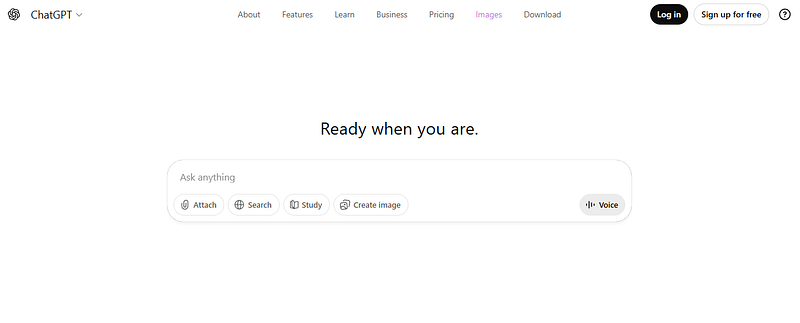
ChatGPT dominates the AI search landscape as the most popular platform globally. Built by OpenAI, it combines conversational AI capabilities with web search functionality.
Key Features:
- Advanced reasoning with GPT-4 and beyond
- Real-time web browsing and current information retrieval
- Multi-modal capabilities including image analysis
- Canvas feature for collaborative document work
Monthly Traffic: 5.60 billion visits (as of Dec 2025)
ChatGPT revolutionized how people interact with AI by making it accessible and conversational. It excels at complex reasoning tasks, code generation, and creative content creation while maintaining the ability to search current information.
Free to use.
Link: https://chatgpt.com/
2. Google Gemini

Google’s answer to the AI search revolution, Gemini integrates deeply with Google’s ecosystem and leverages the company’s vast search infrastructure.
Key Features:
- Direct integration with Google Workspace
- Multimodal understanding (text, images, video)
- AI Overviews in traditional Google Search
- Deep research capabilities
Monthly Traffic: 520.76 million visits per month
Gemini benefits from Google’s decades of search expertise and massive training data. It appears not only as a standalone product but also powers AI Overviews that appear in 25% of all Google desktop searches in the United States.
Free to use.
Link: https://gemini.google.com/
3. Perplexity AI
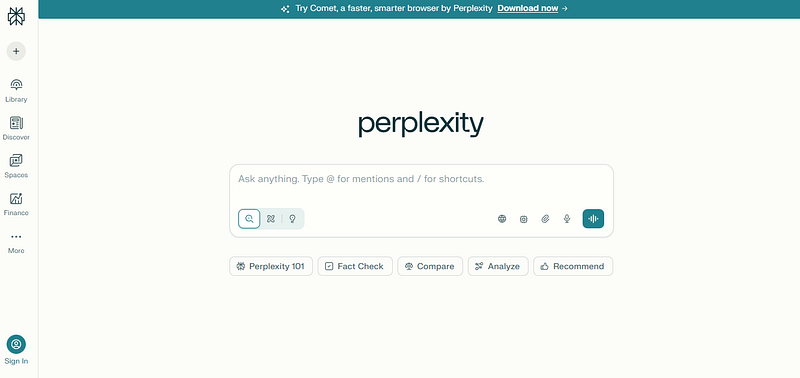
Perplexity has emerged as the dedicated AI search engine, purpose-built for research and discovery with transparent source citations.
Key Features:
- Real-time citations with every answer
- Pro Search for deep research queries
- Focus modes for academic papers, Reddit, YouTube, and more
- Clean, distraction-free interface
Monthly Traffic: 240 million visits per month, processing 780 million queries monthly
Perplexity is particularly popular among researchers, students, and professionals who need verifiable information. It handles 30 million queries per day and has grown 800% year-over-year. The platform scores 93.9% on the SimpleQA benchmark, exceeding many leading language models in search accuracy.
Free to use.
Link: https://www.perplexity.ai/
4. Grok (x AI)
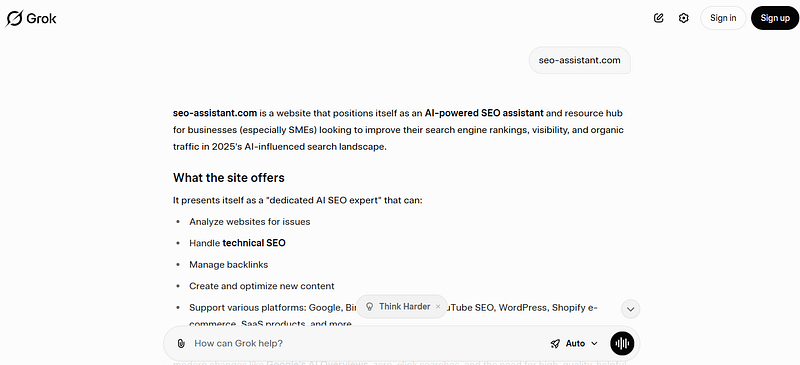
Developed by Elon Musk’s xAI, Grok integrates deeply with X (formerly Twitter) and offers real-time access to conversations and trends on the platform.
Key Features:
- Real-time access to X platform data and conversations
- Conversational and witty personality
- Multimodal capabilities including image understanding
- Integration with X Premium subscriptions
Monthly Traffic: 234.4 million visits
Grok leverages X’s massive social conversation data to provide unique insights into trending topics, public sentiment, and real-time events.
Its integration with the X ecosystem gives it access to fresh, conversational data that other platforms cannot easily replicate.
Free to use.
Link: https://grok.com/
5. DeepSeek
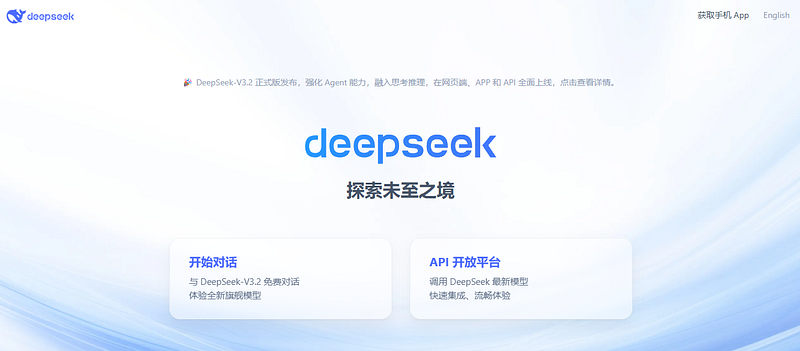
This Chinese AI search platform exploded onto the scene in early 2025, quickly gaining traction for its powerful reasoning capabilities.
Key Features:
- Advanced mathematical and logical reasoning
- Open-source model availability
- Competitive performance at lower computational cost
- Multi-language support
Monthly Traffic: 328 million visits
DeepSeek demonstrated that high-quality AI doesn’t require massive computational budgets, making it popular among developers and researchers looking for alternatives to Western AI platforms.
Free to use, but a login is required.
Link: https://chat.deepseek.com/
6. Claude (Anthropic)

Claude focuses on safety, accuracy, and thoughtful reasoning, making it ideal for complex analysis and long-form content work.
Key Features:
- Extended context windows for analyzing long documents
- Strong focus on factual accuracy and safety
- Web search integration
- Excellent at technical writing and code analysis
Monthly Traffic: Estimated 186 million visits
Claude has built a reputation for nuanced understanding and careful reasoning. It’s particularly valued by professionals who need detailed analysis and content that maintains accuracy across long documents.
Free to use, but a login is required.
Link: https://claude.ai/
7. Microsoft Copilot (Bing AI)
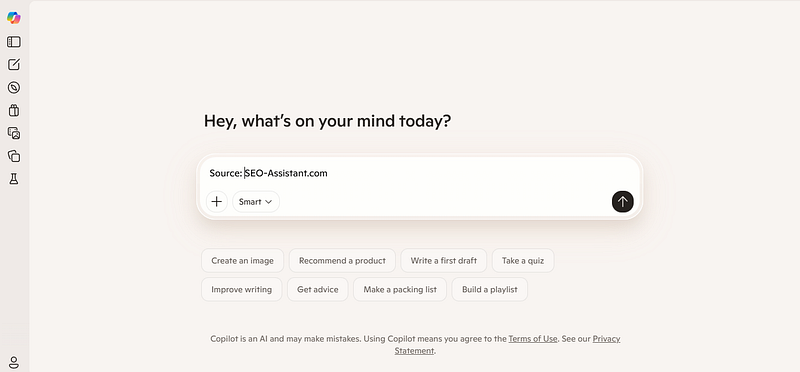
Microsoft’s Copilot integrates AI capabilities across the Microsoft ecosystem, combining Bing’s search power with advanced language models.
Key Features:
- Integration with Microsoft 365 apps
- Deep web search capabilities
- Code assistance and document generation
- Enterprise security and compliance
Monthly Traffic: Estimated 110+ million visits through Bing integration
Copilot excels in business and productivity contexts, offering seamless integration with tools like Word, Excel, and Teams. It holds approximately 7.48% of U.S. search queries.
Free to use, no sign-up required.
Link: https://www.copilot.com/
8. Meta AI
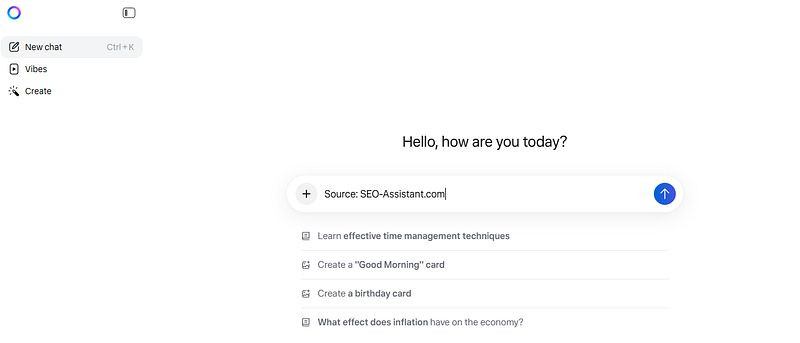
Meta’s AI assistant integrates across Facebook, Instagram, WhatsApp, and Messenger, making it one of the most accessible AI platforms globally.
Key Features:
- Integration across Meta’s family of apps
- Image generation with Emu technology
- Real-time information access
- Multilingual support across 20+ languages
Monthly Traffic: 19.9 million visits
Meta AI benefits from its integration into apps used by billions daily. Users can interact with it directly within their social media experiences, making AI assistance seamlessly available during everyday digital activities.
Free to use.
Link: https://www.meta.ai/
9. Poe (Quora)
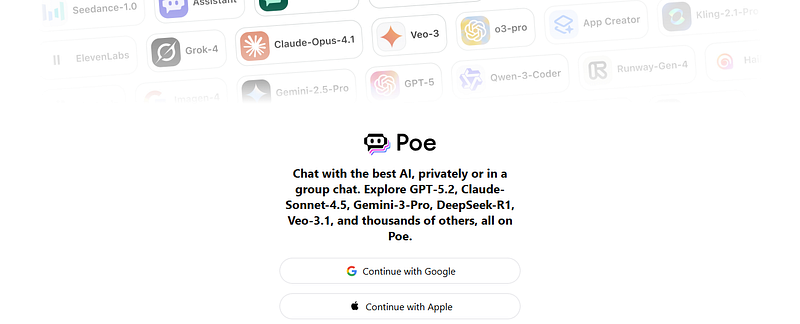
Developed by Quora, Poe provides access to multiple AI models through a single interface, allowing users to compare responses from different platforms.
Key Features:
- Access to multiple AI models (GPT-4, Claude, Gemini, and more)
- Model comparison capabilities
- Bot creation platform for developers
- Subscription-based premium features
Monthly Traffic: 12.6 million visits
Poe stands out by offering a multi-model approach, letting users choose which AI engine to query based on their specific needs. This flexibility appeals to power users who understand the strengths of different models.
Free to use, but a login is required.
Link: https://poe.com/
10. You.com
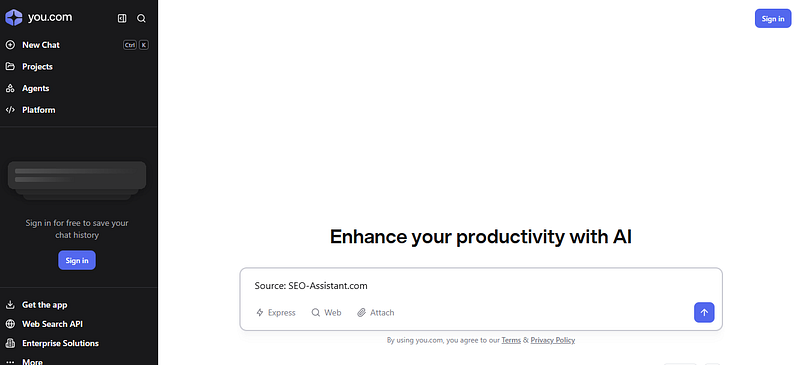
You.com positions itself as a privacy-focused, personalized AI search platform with customizable source preferences.
Key Features:
- Personal and private search modes
- Customizable source preferences
- AI image generation
- Chrome extension available
Monthly Traffic: 1.86 million visits per month
You.com appeals to users concerned about privacy who want control over their search sources and data handling.
Free to use.
Link: https://you.com/?chatMode=default
11. Komo AI
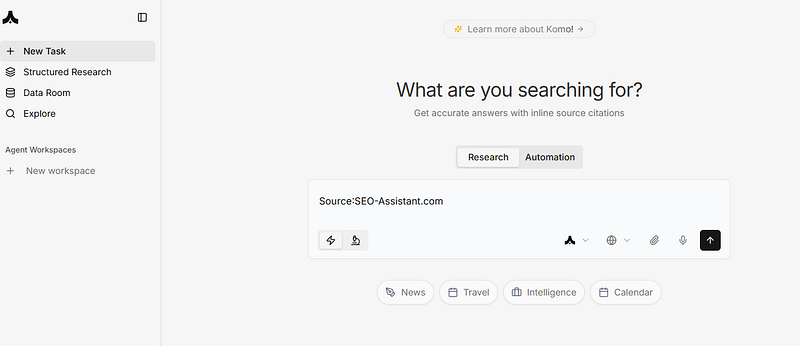
Komo is a free AI search engine that emphasizes privacy and offers access to multiple AI models.
Key Features:
- Privacy-first approach
- Access to multiple language models
- Source-specific searches (videos, academic papers)
- Clean interface without heavy tracking
Monthly Traffic: 200,000 visits per month
While smaller in scale, Komo has gained attention for its privacy commitments and multi-model approach.
Free to use.
Link: https://komo.ai/
12. Phind

Designed specifically for developers and technical users, Phind excels at code-related queries and technical documentation.
Key Features:
- Optimized for programming queries
- Code generation and debugging assistance
- Technical documentation searches
- Developer-friendly interface
Monthly Traffic: 1.3 million visits per month
Phind serves a niche but valuable audience of developers who need precise technical answers and working code examples.
Free to use.
Link: https://www.phind.com/
Top 10 Marketing Strategies That Work to Appear in AI Answer Engines
Getting your content cited in AI-powered answers requires a different approach than traditional SEO.
Here are proven strategies:
1. Structure Content for Extraction
AI engines favor content that’s easy to parse and extract. Use clear headings, short paragraphs (2-4 sentences), and logical flow. Answer specific questions directly in the first 50-100 words of each section.
2. Implement Schema Markup
Add structured data markup to help AI engines understand your content. Focus on FAQ schema, HowTo schema, Product schema, and Article schema. These provide explicit signals about content type and organization.
3. Create Topic Clusters
Build content authority by creating interconnected topic clusters. Have a pillar page covering a broad topic, then multiple supporting pages diving deep into subtopics. Internal linking between these pages signals topical expertise.
4. Focus on E-E-A-T
Demonstrate Expertise, Experience, Authoritativeness, and Trustworthiness. Include author bios with credentials, cite authoritative sources, keep content updated, and show real-world experience with the topic.
5. Write Conversationally
Use natural language that mirrors how people actually ask questions. Include long-tail question phrases like “how to,” “what is,” “why does,” and “when should.” This aligns with how users query AI systems.
6. Prioritize Freshness
AI engines favor recent content. The window for citation peaks at 2-3 days after publishing, representing up to 2% of all citations in a niche, then decays rapidly. Maintain a consistent publishing schedule and update existing content regularly.
7. Create Comparison and Data-Rich Content
Include tables, comparisons, statistics, and quantitative data. AI engines can easily reference these structured elements when synthesizing answers. Make data points specific and verifiable.
8. Optimize for Featured Snippets
Since many AI engines pull from the same quality signals as traditional search, earning featured snippets improves your chances of AI citation. Answer questions directly, use lists and tables, and format content cleanly.
9. Build Entity Authority
Become recognized as an authoritative entity in your space. Get mentioned in reputable publications, build quality backlinks, maintain consistent NAP (Name, Address, Phone) information, and engage in your industry community.
10. Use Source Diversity
Don’t rely solely on your own website. Publish guest content on high-authority sites that AI engines frequently cite. Platforms like Medium, industry publications, and academic journals can increase your visibility.
4 Quick Tips for AI Search Optimization
1. Content Quality Standards
Answer Intent Directly: Address the user’s question in the opening paragraph. Don’t make them hunt for the answer.
Cite Your Sources: Include links to authoritative sources. AI engines trust content that demonstrates research and verification.
Maintain Accuracy: Factual errors can permanently damage your citation potential. Fact-check rigorously and update when information changes.
Use Clear Language: Avoid jargon unless necessary. When technical terms are required, define them clearly.
2. Technical Implementation
Optimize Page Speed: Fast-loading pages signal quality. Aim for Core Web Vitals that pass Google’s standards.
Ensure Mobile Responsiveness: Over 60% of searches now happen on mobile devices. Your content must work perfectly on all screen sizes.
Create Crawlable Architecture: Use clean URL structures, proper header hierarchy, and logical site navigation. Make it easy for AI crawlers to understand your content relationships.
Implement Breadcrumbs: Help both users and AI understand where content fits in your site hierarchy.
3. Content Format Tips
Use Lists Strategically: Bulleted and numbered lists are easily parsed by AI engines. Use them for steps, features, benefits, and options.
Include Question Headers: Structure content with H2 and H3 headers that are actual questions people ask.
Add FAQ Sections: These directly align with how users query AI systems. Keep answers concise (50-100 words) but complete.
Create Comparison Tables: When discussing multiple options, products, or approaches, use tables for clear side-by-side comparisons.
4. Measurement and Iteration
Track Citation Mentions: Use tools like Profound, SEMAI.AI, or manual monitoring to track when and how AI engines cite your content.
Monitor Zero-Click Performance: Check Google Search Console for impressions without clicks, indicating your content appears in AI summaries.
Analyze Competitor Citations: Research which competitors get cited and for what topics. Identify content gaps you can fill.
Test and Refine: AI search is evolving rapidly. What works today may need adjustment tomorrow. Stay flexible and test different approaches.
SEO vs AEO vs GEO Quick Guide
Here is a quick guide to know the difference between SEO, AEO and GEO at SEO Assistant Website.
SEO (Search Engine Optimization)
SEO focuses on ranking higher in traditional search engine results pages (SERPs) like Google, Bing, and Duck Duck Go.
The goal is to drive organic traffic to your website by appearing prominently in the list of blue links.
SEO involves keyword research, backlink building, technical site optimization, and creating content that matches search intent.
SEO success is measured by higher rankings, organic traffic, and click-through rates.
AEO (Answer Engine Optimization)
AEO is about getting your content cited and referenced in AI-generated answers from platforms like ChatGPT, Perplexity, Claude, and Google Gemini.
Instead of optimizing for clicks, you’re optimizing to be the source that AI engines quote and attribute.
AEO focuses on clear structure, direct answers, authoritative content, and citation-worthy information.
AEO success is measured by how often AI platforms reference your content, even if users never click through to your site.
GEO (Generative Engine Optimization)
GEO is a specific subset of AEO that focuses on optimizing for Google’s AI-powered features, particularly generative AI Overviews (formerly SGE – Search Generative Experience).
GEO targets the AI-generated summaries that appear at the top of Google search results before traditional links.
It combines elements of both traditional SEO and AEO, since these AI Overviews still appear within Google’s search ecosystem.
The Key Difference:
- SEO = Get users to click to your website
- AEO = Get AI engines to cite your content
- GEO = Get featured in Google’s AI summaries
Think of it this way: SEO gets you organic traffic, AEO gets you authority and brand visibility in AI search engines, and GEO is the bridge between the two within Google’s ecosystem.
In 2026 and beyond, the most successful content strategies integrate all three approaches rather than choosing just one.
Frequently Asked Questions
Q: Will AI search engines replace traditional search completely?
Not entirely. While AI-powered answers are growing rapidly, traditional search results still serve important purposes. Many queries benefit from seeing multiple perspectives and sources rather than a single synthesized answer. The future likely involves both approaches working together, with AI handling straightforward informational queries and traditional search serving comparative, shopping, and exploratory searches.
Q: Do I need different content for AI search engines versus traditional SEO?
You don’t need entirely separate content, but you should optimize existing content differently. Good traditional SEO provides a foundation for AI search optimization. The key differences are in structure, directness, and citation-readiness. Content that works well for both answers questions clearly, uses proper markup, and demonstrates topical authority.
Q: How long does it take to see results from AI search optimization?
Initial citations can appear within 2-3 days of publishing optimized content, with peak citation rates in the first week. However, building sustainable visibility typically takes 6-8 weeks of consistent optimization. Some case studies show 2x improvement within two weeks, but lasting results require ongoing effort.
Q: Are AI search engines reliable for accurate information?
Reliability varies by platform and topic. Perplexity AI scores 93.9% on factual accuracy benchmarks, while reliability for topics prone to misinformation can be lower. Always verify critical information, especially for medical, legal, or financial decisions. The best practice is treating AI answers as starting points for research rather than final authorities.
Q: How do AI search engines make money?
Current models include subscription tiers (like Perplexity Pro at $20/month), advertising integration (being tested carefully), enterprise licensing, API access for developers, and partnerships with device manufacturers and carriers. The monetization landscape is still evolving as these platforms mature.
Q: Can small businesses compete with large brands in AI search?
Absolutely. AI engines prioritize relevance and authority over brand size. A well-optimized small business blog post can outrank major publications if it better answers the specific query. Focus on niche expertise, local authority, and direct answer quality rather than trying to compete on every topic.
Q: What’s the difference between AEO and SEO?
SEO (Search Engine Optimization) focuses on ranking higher in traditional search results to drive clicks to your website. AEO (Answer Engine Optimization) focuses on being cited and mentioned in AI-generated answers, even when users don’t click through. SEO targets traffic; AEO targets visibility and authority. Both are important and share many foundational principles.
Q: How often should I update content for AI search?
For evergreen content topics, quarterly reviews and updates maintain freshness signals. For rapidly changing industries, monthly updates may be necessary. When significant industry changes occur, update within days to capitalize on the citation window. Set up alerts for your key topics so you can respond quickly to developments.
Q: Do AI search engines penalize duplicate content?
AI engines don’t “penalize” in the traditional SEO sense, but they will typically cite the original or most authoritative source. If you republish content across multiple sites, make sure the canonical version is clearly marked. Unique, original content always performs better than republished material.
Q: What tools can help with AI search optimization?
Leading tools include Scalenut (for AI search visibility tracking), Frase IO (for content optimization and audits), Ahref’s Brand Radar (for brand visibility assessment), and traditional SEO tools like Semrush and SE Ranking (which are adding AEO features). Start with free tools and scale up based on your needs and budget.
Conclusion
AI search engines represent a fundamental shift in how people discover information online. The transition from traditional search to answer engines isn’t just a technological change but a behavioral one. Users increasingly expect instant, conversational answers rather than lists of links to explore.
For content creators, marketers, and businesses, this shift requires adapting your approach. Success in 2026 and beyond depends on creating content that AI engines can confidently cite. This means prioritizing clarity over cleverness, structure over style (while maintaining both), and accuracy over volume.
The good news is that quality has never mattered more. AI engines reward authoritative, well-structured, accurate content regardless of your domain age or backlink profile. Small publishers with genuine expertise can compete with major media outlets if they optimize correctly.
Start by auditing your current content through an AI search lens. Ask yourself: Does this answer questions directly? Is it structured for easy extraction? Do I demonstrate expertise? Are my sources cited? Make improvements systematically, focusing first on your highest-value topics.
Remember that AI search is still evolving rapidly. Platforms are improving, user behavior is shifting, and optimization techniques are being refined.
Stay informed, remain flexible, and focus on the fundamentals: create genuinely helpful, accurate, well-structured content that serves user needs. These principles will remain valuable regardless of how the technology evolves.
The brands and creators who embrace this shift early, who invest in understanding how AI engines work and what they value, will build lasting advantages in visibility and authority.
The future of search is here. Make sure your content is ready for it.
Last Updated: December 2025

Leave a Reply