The perfect domain name is sitting right there in your mind.
Clear, memorable, exactly what your business needs.
Then you check availability and… it’s taken. Your perfect .com is taken.
That dot com you wanted is not available.
Probably on sale or already in use by someone who registered it a decade ago.
Here’s the reality: with over 159 million .com domains already registered, finding an available .com that actually matches your brand is increasingly difficult.
But this isn’t the crisis it used to be.
The domain landscape has evolved dramatically, and alternatives to .com can actually strengthen your brand identity rather than weaken it.
Let me walk you through the 10 best domain extension alternatives, what makes each one valuable, and how to choose the right one for your business.
Top 10 Alternatives to .com Domains in 2026
If you can’t get your ideal .com domain? SEO Assistant helps you discover the most relevant domain extension alternatives from .co to .store.
1. .CO – The Global Business Alternative
Originally the country code for Colombia, .co has evolved into a globally recognized alternative that’s nearly indistinguishable from .com in many contexts.
Key Features:
- Short, memorable, and professional
- Strong association with “company” and “commercial”
- Widely trusted by consumers and businesses
- No restrictions on who can register
Pros:
- Extremely close to .com in appearance and perception
- Premium domain registrar support
- Works well for startups and established businesses
- Strong for branding purposes
Cons:
- Slightly higher annual registration costs ($25-40 vs $10-20 for .com domain renewal)
- Some users might accidentally type .com instead
- Less familiar to older, less tech-savvy audiences
Real Website Examples for .CO domain extension:
- chatbase.co (AI Agents for Customer Service)
- duda.co (Website Builder, AI-Ready website platform)
- huggingface.co (AI Community Platform)
- seo.co (AI SEO Services, generative engine optimization agency)
Website Use Case: If you’re building a startup or modern business, .co signals innovation and forward-thinking.
The extension has gained substantial credibility in the tech world, making it particularly effective for SaaS companies, digital agencies, and online platforms.
It’s close enough to .com that most users won’t question it, yet distinctive enough to help your brand stand out.
Here’s an example for our brand name “SEO Assistant“. seoassistant.co is available at Namecheap with 63% off.
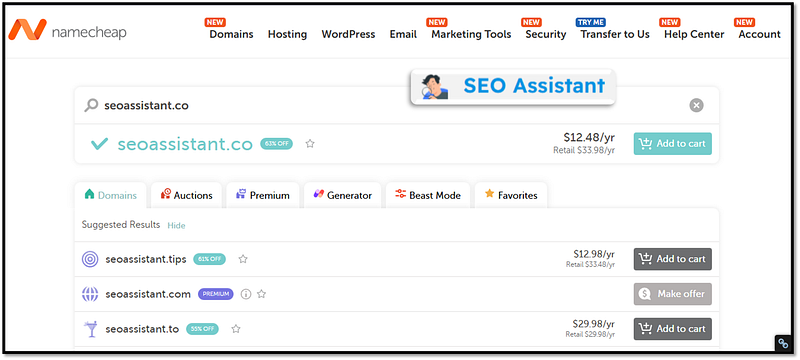
Search for a .CO domain name at Namecheap.
2. .IO – The Tech Startup Favorite
Technically the country code for British Indian Ocean Territory, .io has become the unofficial domain of choice for tech companies, particularly in the SaaS and developer tool space.
Key Features:
- Strong tech industry association
- Short and clean appearance
- “Input/Output” connection appeals to developers
- Premium positioning in the market
Pros:
- Instantly signals that you’re a tech company
- Highly valued in startup and developer communities
- Memorable and modern
- Excellent for SaaS, APIs, and development tools
Cons:
- Higher cost ($40-100 annually)
- Strong tech association may limit appeal for non-tech businesses
- Some ethical concerns about the territory’s history
- Less suitable for traditional industries
Real Website Examples with .IO Domain:
- frase.io (AI SEO, SEO + GEO optimization platform)
- outranking.io (End-to-end SEO workflow platform)
- systeme.io (Business Launch, All-in-one marketing platform)
- keybase.io (Secure messaging platform)
Business Use Case: If you’re launching a developer tool, SaaS platform, or tech startup, .io immediately positions you within the right ecosystem.
Investors, early adopters, and tech-savvy users recognize and trust this extension.
It’s particularly effective when your product name is a single word or short phrase that might be impossible to secure as a .com.
Search for a .IO domain name at Namecheap.
3. .AI – Perfect for Artificial Intelligence Ventures
The country code for Anguilla that has become synonymous with artificial intelligence companies and machine learning platforms.
Key Features:
- Direct association with artificial intelligence
- Premium domain pricing reflects high demand
- Growing recognition and trust
- Tech-forward image
Pros:
- Perfect branding for AI, ML, and data science companies
- Signals innovation and cutting-edge technology
- Increasingly recognized by mainstream audiences
- Strong investor appeal in the AI sector
Cons:
- Expensive ($80-200+ annually)
- Very specific industry association limits versatility
- Not ideal for non-AI businesses
- Premium domains can cost thousands
6 AI Domain Real Website Examples:
- ranked.ai (AI SEO & PPC services platform)
- galaxy.ai (All-in-one AI platform)
- customgpt.ai (AI custom GPT platform)
- brandwell.ai (AI-powered DIY SEO Platform)
- expertise.ai (Demand Conversion AI platform)
- perplexity.ai (AI answer engine platform)
Business Use Case: If artificial intelligence is core to your product or service, .ai isn’t just an alternative to .com, it’s actually superior for your branding.
It immediately communicates what you do and positions you within the AI industry.
For AI startups seeking funding or partnerships, this extension provides instant context and credibility.
Search for a .AI domain name at Namecheap.
4. .APP – Built for Applications
A generic top-level domain (gTLD) specifically designed for apps and application-related websites, backed by Google and requiring HTTPS security.
Key Features:
- Mandatory HTTPS security (built-in trust)
- Clearly indicates an application or software
- Google-backed infrastructure
- Universal appeal across platforms
Pros:
- Enhanced security through required SSL certificates
- Clear purpose and meaning
- Works for mobile apps, web apps, and software
- Strong brand alignment for application developers
Cons:
- Requires HTTPS setup (though this is a best practice anyway)
- Moderate cost ($15-25 annually)
- Less established than older alternatives
- May seem limiting if you expand beyond apps
Four Dot APP Real Website Examples:
- get.app (Google’s domain registry platform)
- podcast.app (Podcast platform)
- windy.app (Weather forecast platform)
- chatbot.app (AI chatbot platform)
Business Use Case: When you’re building software, whether it’s a mobile app, web application, or desktop software, .app immediately clarifies what you offer.
Users know what to expect before they even visit your site. The mandatory security also builds trust, particularly important for apps that handle user data or transactions.
Search for a .APP domain name at Namecheap.
5. .NET – The Original Alternative
One of the original top-level domains from 1985, initially intended for network infrastructure but now used broadly.
Key Features:
- Long-established credibility
- Second only to .com in recognition
- No usage restrictions
- Widely available and affordable
Pros:
- High user trust and familiarity
- Excellent .com substitute for almost any business
- Affordable ($10-20 annually)
- Works well for network, internet, and tech services
- Strong SEO performance
Cons:
- Can seem dated compared to newer alternatives
- Users often default to .com in their minds
- Less distinctive for branding purposes
- Doesn’t provide specific industry context
4 Real Website Examples with .NET Domain:
- behance.net (Creative portfolio platform)
- speedtest.net (Internet speed testing)
- media.net (The sell side platform)
- chatbuilder.net (The chatbot building platform)
Business Use Case: .Net works as a straightforward .com replacement when you need something universally recognized and trusted.
It’s particularly effective for internet services, online communities, networking platforms, or technology infrastructure.
While it doesn’t make a bold statement, it also doesn’t raise any red flags with users who might be skeptical of newer extensions.
Search for a .NET domain name at Namecheap.
6. .STORE – Ideal for E-commerce
A new gTLD designed specifically for online retail and e-commerce businesses.
Key Features:
- Clear commercial intent
- Purpose-built for shopping sites
- Growing recognition in e-commerce
- Descriptive and direct
Pros:
- Instantly communicates that you sell products
- Great for online stores and marketplaces
- Helps with brand clarity
- Good availability of desirable names
- Moderate pricing ($15-30 annually)
Cons:
- Limited to retail/e-commerce contexts
- Newer extension with less widespread recognition
- May not work well for service-based businesses
- Some user hesitation with newer TLDs
4 Website Examples with .store extension:
- get.store (Store domain registry platform)
- prime.store (The payment marketplace)
- mrbeast.store (Mr Beast Merch Store)
- emirates.store (Emirates Official Store)
Business Use Case: If you’re running an online shop, .store eliminates any confusion about what your site does.
It helps with SEO since the extension itself is a keyword, and it can actually increase click-through rates from search results because users immediately know you’re selling products.
This is particularly valuable for niche retailers where the product category + .store creates a perfect brand match.
7. .TECH – For Technology Companies
A gTLD targeting technology businesses, startups, and tech-focused websites.
Key Features:
- Technology industry alignment
- Modern and professional appearance
- Broad applicability within tech sector
- Reasonable pricing
Pros:
- Works across all technology niches
- More affordable than .ai ($40-80 annually)
- Professional and credible
- Good name availability
- Clear industry positioning
Cons:
- Less established than .io in startup culture
- May seem generic for very specific tech niches
- Some user unfamiliarity
- Competitive with other tech-focused TLDs
4 Real Website Examples for .Tech Domain Extension:
- shadow.tech (PC Cloud gaming platform)
- nothing.tech (Smartphone platform)
- rabbit.tech (AI assistant device platform)
- suresh.tech (AI marketing expert platform)
Business Use Case: .Tech provides the technology association of .io but with better availability and lower costs.
It works well for tech consulting firms, IT service providers, tech blogs, and technology products that aren’t specifically SaaS or developer tools.
It’s versatile enough to work for both B2B and B2C tech businesses while still clearly signaling your industry.
8. .ONLINE – The Universal Digital Presence
A broadly applicable gTLD that works for virtually any online business or presence.
Key Features:
- Maximum flexibility
- Clear digital/internet association
- Affordable pricing
- Good name availability
Pros:
- Works for any industry or purpose
- Emphasizes your digital presence
- Medium cost ($25-50 annually)
- Easy to understand and remember
- Growing acceptance
Cons:
- Very generic, less distinctive for branding
- Doesn’t provide industry context
- Newer extension with moderate recognition
- Can seem like a fallback choice
Examples:
- domain.online (Domain community platform)
- news.online (News sharing platform)
- game.online (gaming platform)
- courses.online (education platform)
Business Use Case: .Online is the Swiss Army knife of domain extensions. When your .com is taken but you want something universally appropriate, .online works for blogs, personal brands, service businesses, communities, or portfolios.
It emphasizes that you’re a digital-first business, which can be valuable for companies transitioning from offline to online or building purely digital brands.
9. .CLUB – For Communities and Memberships
A domain extension designed for communities, clubs, membership sites, and group-focused websites.
Key Features:
- Community and membership association
- Friendly and approachable tone
- Affordable pricing
- Versatile usage
Pros:
- Perfect for membership sites and communities
- Creates sense of exclusivity and belonging
- Works for hobbies, interests, and fan sites
- Low cost ($20-30 annually)
- Memorable and distinctive
Cons:
- Casual tone may not suit all businesses
- Limited professional/corporate applications
- Less suitable for traditional businesses
- Niche positioning
Examples:
- creator.club (creator community platform)
- book.club (reading communities)
- fitness.club (workout communities)
- comedy.club (comedian platform)
Business Use Case: If you’re building a community, fan site, membership platform, or interest-based group, .club reinforces the collaborative nature of your platform.
It signals to potential members that they’re joining something, not just visiting a website.
This works exceptionally well for subscription services, online communities, hobby sites, and platforms built around shared interests.
10. .ORG – For Organizations and Nonprofits
One of the original TLDs from 1985, traditionally associated with non-profits but available to anyone.
Key Features:
- High credibility and trust
- Strong non-profit association
- Long-established presence
- Universal recognition
Pros:
- Excellent trust factor
- Perfect for nonprofits, NGOs, and community organizations
- One of the most recognized extensions after .com
- Affordable ($10-20 annually)
- Strong SEO performance
Cons:
- Strong non-profit association may confuse users for commercial sites
- Less suitable for profit-driven businesses
- May undermine commercial positioning
- Users expect certain types of content
4 Real Website Examples with .ORG extension:
- icann.org (Internet Corporation Platform)
- craigslist.org (classified advertisements)
- wikipedia.org (The free encyclopedia)
- archive.org (Internet archive platform)
Business Use Case: If you’re running a nonprofit, community initiative, open-source project, or mission-driven organization, .org provides instant credibility and trust.
Even some commercial platforms use .org successfully when their mission extends beyond pure profit.
The extension signals purpose, community, and trustworthiness, which can be powerful for organizations focused on social impact.
How to Choose the Right Alternative Domain Extension
Selecting the best alternative depends on several factors specific to your business:
Industry Alignment: Match the extension to your sector. Tech startups should consider .io, .ai, or .tech. E-commerce sites benefit from .store. Communities thrive with .club.
Brand Identity: Consider what the extension communicates. Does .co suggest the modern startup you want to be? Does .org align with your mission-driven values?
Target Audience: Think about who you’re serving. Tech-savvy millennials readily accept new extensions like .io and .app. Older or less technical audiences might respond better to established options like .net or .org.
Budget Considerations: Extension costs vary significantly. .Com alternatives like .net and .online run $10-15 annually, while .ai and .io can cost $50-200+ per year.
Long-term Strategy: Consider where your business is heading. If you might expand beyond your current focus, choose something versatile like .co or .online rather than highly specific options like .ai or .store.
Brand Protection: Whatever you choose, consider registering multiple variations to protect your brand and prevent confusion. Many businesses secure their name with multiple extensions and redirect them all to their primary domain.
Common Questions About Domain Alternatives
Are alternative domain extensions bad for SEO?
No. Google has repeatedly confirmed that domain extensions don’t directly impact search rankings. What matters is content quality, site structure, backlinks, and user experience. Both .com sites and alternative TLD sites can rank equally well. However, user behavior might differ slightly as people tend to trust familiar extensions more, which could indirectly affect metrics like click-through rate.
Will customers trust my business with a non-.com domain?
Trust depends more on your extension choice and overall brand presentation than simply avoiding .com. Established alternatives like .net, .org, and .co carry high trust. Newer but purpose-driven extensions like .io (for tech) or .store (for e-commerce) build trust through clarity. Generic or spammy-sounding extensions should be avoided. Your website design, security certificates, and professional presentation matter far more than the extension itself.
Should I buy the .com version even if I use an alternative?
If you can afford it and the .com is available for purchase (not just taken), buying it provides brand protection and prevents confusion. You can redirect the .com to your alternative extension. However, if the .com is held by someone asking thousands of dollars, investing that money in marketing your alternative domain often provides better ROI than overpaying for the .com.
Can I switch to .com later if it becomes available?
Yes, but it comes with costs. You’ll need to implement proper 301 redirects, update all marketing materials, notify customers, and rebuild some SEO authority. Many successful companies have made this transition, but it’s easier to start with your permanent domain. If switching is a real possibility, choose an alternative that’s easy to migrate from, like .co or .net.
Do alternative extensions work for email addresses?
Absolutely. Professional email addresses work with any domain extension. Having an email like hello@yourdomainname.io or contact@yourdomainname.store looks professional and legitimate. Some alternatives like .co and .net are so established that recipients won’t think twice about them.
Which industries accept alternative domains most readily?
Technology, startups, creative services, and e-commerce lead in adopting alternative domains. These industries value innovation and their audiences tend to be more digitally savvy. Traditional industries like law, finance, and healthcare move more slowly but are increasingly accepting alternatives, especially .net and .co.
Choose the perfect .com alternative
The .com domain you wanted might be taken, but that doesn’t mean compromising on your brand.
The right alternative extension can actually strengthen your positioning, clarify your purpose, and help you stand out in crowded markets.
Start by securing your domain before someone else does.
Names disappear daily, and waiting could mean losing your preferred option across multiple extensions.
Register your primary choice now, then consider protective registrations of close alternatives to prevent brand confusion.
Build your brand confidently with whatever extension you choose. Your success won’t come from your domain extension.
It will come from the value you provide, the experience you create, and the relationships you build with customers.
The most successful companies today use every extension imaginable, proving that great businesses transcend their URLs.
The domain landscape has fundamentally changed. You’re not settling for a “backup option.” You’re choosing a strategic positioning tool that tells visitors exactly who you are and what you do.
Make that choice deliberately, register it today, and start building the online presence your business deserves.
Need help? Contact SEO Assistant team today!
Leave a Reply